

Renovation or Restoration | Restoring the beauty of a home for contemporary life
There is a subtle, but important, distinction between renovation and restoration. It is a distinction that often defines the outcome of a home long before construction begins. In many cases, the two terms are used interchangeably. Both involve working with an existing building. Both respond to changing needs and evolving lifestyles. Yet the mindset behind each approach is fundamentally different.
A renovation often asks, how can we update this home?
A restoration asks, what is worth keeping, and how can we build upon it?
Homes as layered stories
Some of the most enduring homes we encounter are not defined by scale or finish, but by their character.
Mid-century coastal homes. Modest period dwellings. Houses that carry the imprint of time through their materials, proportions and relationship to landscape.
These homes often have a clear and distinct ‘Why’, or vision. Exposed beams that express structure. Windows positioned for light and breeze. Verandahs that mediate between indoors and out. Materials that weather and soften over time.
They hold a story.
When we approach these homes through a purely renovation-focused lens, there is a risk that this story is diluted. Original elements are removed. Proportions are altered. Layers are stripped back without understanding what gave the home its identity in the first place.
Restoration takes a different path.
It begins with observation. With restraint. With a willingness to understand before intervening.
Not every home needs to be reimagined
There is a tendency in contemporary projects to reshape homes entirely. To reconfigure, reclad and redefine until very little of the original remains.
In some cases, this is necessary, yet for many of these beautiful original homes it isn’t.
We have seen mid-century homes where the instinct is to “modernise” by simplifying. Exposed timbers are painted over. Textured materials are replaced with flat, minimal surfaces. The richness of the original architecture is reduced in pursuit of a more current aesthetic.
In doing this, something is lost. A home designed with warmth, depth and material expression becomes neutral.
Restoration resists this impulse. It does not seek to turn a mid-century home into something it was never intended to be. It does not attempt to impose a new architectural language where an existing one already exists. Instead, it works with what is there.
Working with, not against
A restored home does not remain frozen in time. It evolves, but in a way that feels aligned.
This might mean retaining original ceiling heights and structural rhythms rather than flattening them. Allowing exposed beams to remain visible, repaired and celebrated. Introducing new materials that sit comfortably alongside the existing palette, rather than competing with it.
It means understanding how the home was designed to function.
Where light enters.
How breezes move through the space.
How rooms connect to landscape.
Rather than fighting these qualities, restoration builds upon them.
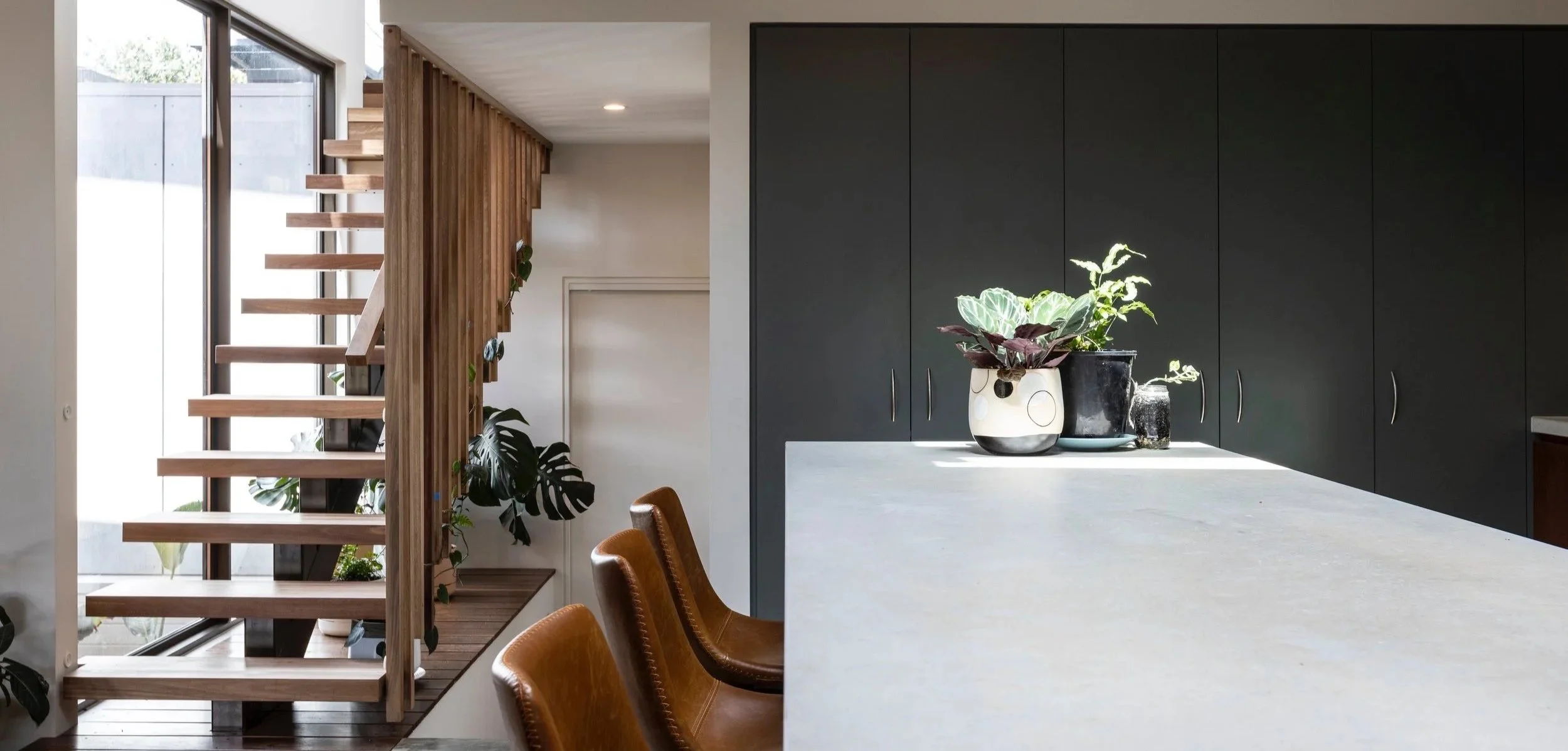
Even when introducing contemporary requirements such as expanded kitchens, additional living spaces or improved amenity, the intention remains consistent. The new work should feel considered in relation to the old, not detached from it.
Performance without erasure
One of the most common challenges with older homes is performance.
Thermal comfort, insulation and glazing often fall short of contemporary expectations. Addressing these issues is essential. However, the way they are resolved determines whether the home retains its character.
Restoration allows for thoughtful upgrades.
Improving insulation within existing wall and roof cavities.
Introducing high-performance glazing that respects original proportions.
Enhancing shading and ventilation without altering the architectural language.
These decisions improve comfort and energy efficiency while maintaining the essence of the home.
Sustainability, in this context, becomes a supporting outcome. Retaining structure reduces embodied carbon. Working with existing materials avoids unnecessary waste. But more importantly, it extends the life of a home that already holds value.
A more considered starting point
For homeowners, the decision to restore rather than renovate begins with clarity.
What do you value about your existing home?
Which elements feel essential to its character?
Where does it fall short in supporting your lifestyle?
Without this understanding, it becomes easy to default to surface-level change. With it, the design process becomes far more intentional.
At Cooper & Blake, we see restoration as an opportunity. Not to preserve a home exactly as it was, but to allow it to evolve without losing what made it meaningful in the first place.
If you are considering working with an existing home, the most valuable step is often the one taken before design begins.
Understanding how you live, what you value and how your home can support that life is what ultimately shapes the outcome.
Our complimentary Find Your Why series has been created to guide homeowners through this process. Across ten days, we share insights drawn from years of experience, helping you approach your project with clarity and intention.